In 2022, Safe Work Australia introduced a model Code of Practice that fundamentally shifted how organisations must approach psychological health and safety at work.
For many leaders, this wasn’t just another compliance update — it was a clear signal:
psychological safety is now a legal responsibility, not a “nice to have.”
From Culture Initiative to Legal Obligation
Under the new regulations, organisations (PCBUs), officers, and workers all carry explicit responsibilities to ensure that people are not exposed to psychosocial risks. This includes identifying hazards, assessing risks, and implementing effective controls.
Importantly, organisations are required to:
- Eliminate psychosocial risks where possible
- Or minimise them so far as is reasonably practicable
- Actively monitor and manage these risks over time
This moves the conversation beyond engagement or wellbeing programs. It places organisational culture and leadership practices squarely in the domain of risk management.
What are psychosocial hazards?
Psychosocial hazards are aspects of work that have the potential to cause psychological or physical harm.
They don’t sit in one place. They emerge from how work is designed, led, experienced, and reinforced every day.
A more practical way to think about them
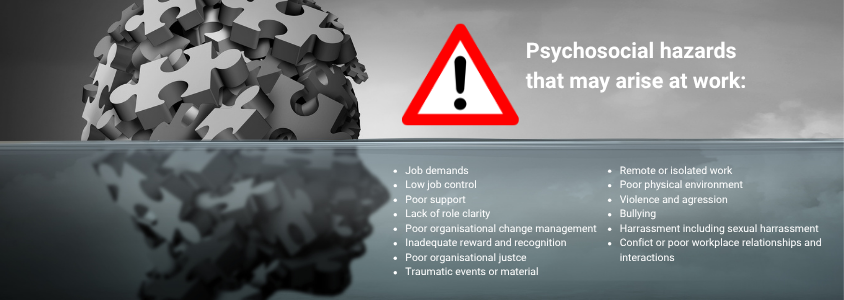
Psychosocial hazards typically arise from four interconnected areas:
1. How work is designed
- Excessive or sustained job demands (mental or emotional)
- Low autonomy or lack of control
- Role ambiguity or conflicting expectations
2. How work is managed
- Poor change management
- Inconsistent or unfair decision-making
- Lack of recognition or feedback
3. The social environment at work
- Poor supervisor or peer support
- Conflict, incivility, or exclusion
- Bullying, harassment, or aggression
4. The broader work context
- Poor physical environments
- Remote or isolated work
- Exposure to traumatic content or events
When these factors are poorly managed, they create chronic strain—not just isolated incidents. And that’s what drives psychological injury.
Importantly, these hazards:
- often interact and compound each other
- are shaped by systems and culture, not just individuals
- vary across teams depending on leadership, structure, and norms
👉 This is why a checklist approach rarely works. You need to understand the system that is producing the risk.
The missing link: Culture drives psychosocial risk
Most organisations approach psychosocial hazards as a list to assess.
But hazards don’t exist in isolation—they are symptoms of how the organisation operates.
Organisational culture shapes:
- how work is structured
- how leaders behave
- what gets rewarded or tolerated
- how people treat each other under pressure
In other words:
Culture is the upstream driver of many psychosocial hazards.
For example:
- A Defensive culture can increase:
- role conflict
- lack of psychological safety
- poor support and blame behaviours
- A Constructive culture tends to reduce:
- harmful behaviours
- ambiguity and stress
- disengagement and withdrawal
This is why organisations often struggle to “fix” psychosocial hazards through policies alone.
You can’t sustainably reduce risk without addressing the cultural conditions creating it.
The Best Culture Survey and Diagnostic Tools for Culture Transformation
Your organisation’s culture is shaping every decision, every interaction, and every result. The Organisational Culture Inventory® (OCI) and Organisational Effectiveness InventoryTM (OEI) are the world’s most widely used culture diagnostics. Together, they give you the clearest picture of your current workplace culture, the causes behind it, and the actions you can take to build the culture you need for success.
Why OCI & OEI give you most of the answers already
For organisations that have completed OCI and OEI:
You likely already have 70–80% of the insight needed to identify and manage psychosocial risks.
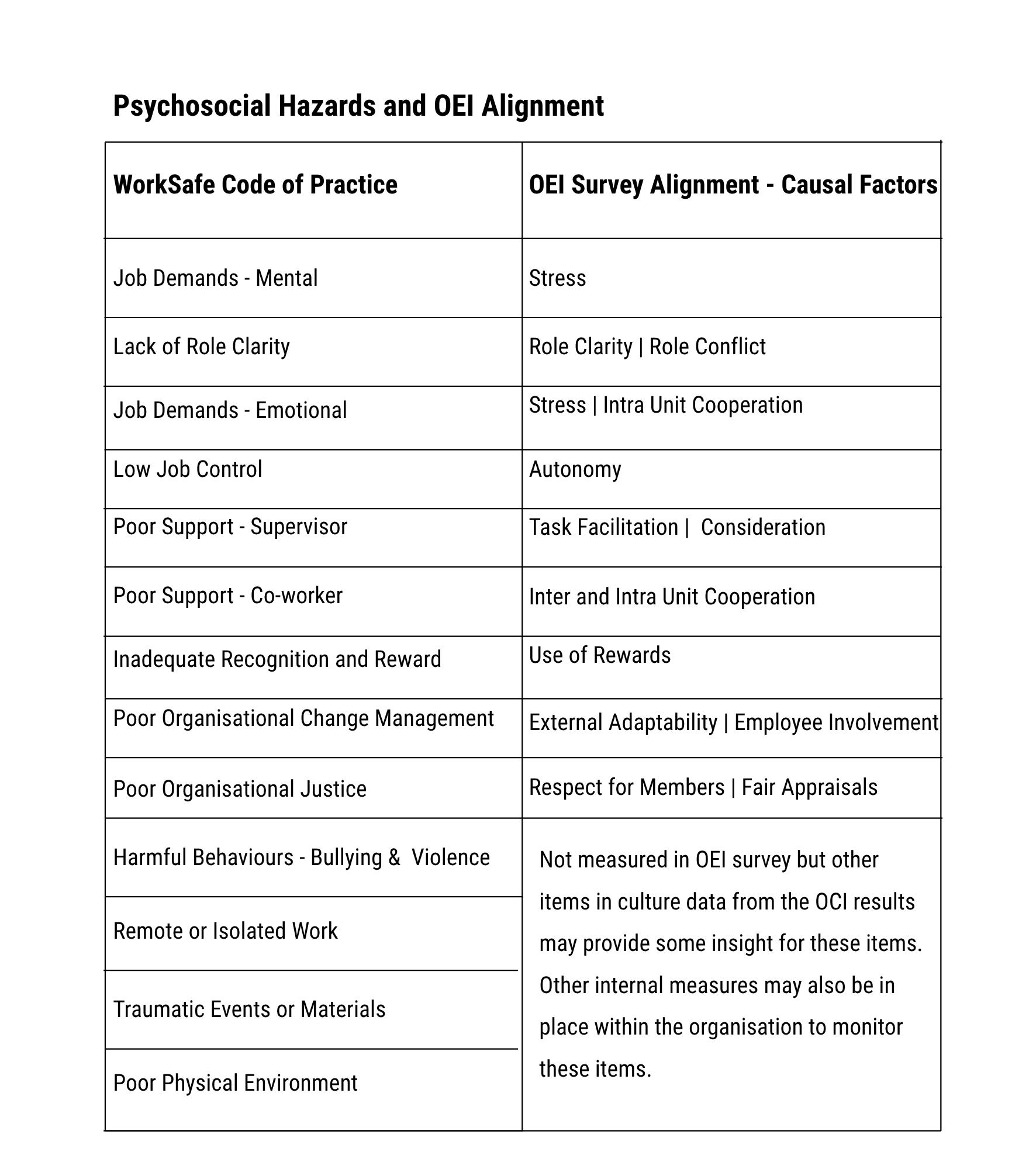
The OEI, in particular, measures the causal factors that directly align with many regulated psychosocial hazards.
This means:
- You don’t need to start from scratch
- You already have data on key risk drivers
- The opportunity is to reinterpret what you have through a psychosocial risk lens
shows that many regulated hazards map directly to OEI factors such as stress, role clarity, autonomy, support, and rewards.
Turning insight into action (for existing clients)
If you’ve already run OCI/OEI, here’s how to make this practical:
Step 1: Reframe your OEI results
Look at causal factors through a risk lens:
- Where are demands high and control low?
- Where is support inconsistent?
- Where is clarity breaking down?
Step 2: Identify “risk clusters”
Psychosocial risk rarely sits in one factor.
Look for combinations like:
- High stress + low role clarity
- Low autonomy + high demands
- Low consideration + low cooperation
These clusters are where risk intensifies.
Step 3: Connect to culture (OCI)
Ask:
- What norms are reinforcing these conditions?
- What behaviours are being rewarded or tolerated?
This is where sustainable change happens.
Step 4: Target interventions upstream
Instead of only:
- training individuals
- adding policies
Focus on:
- leadership behaviours
- systems and structures
- reinforcement mechanisms