
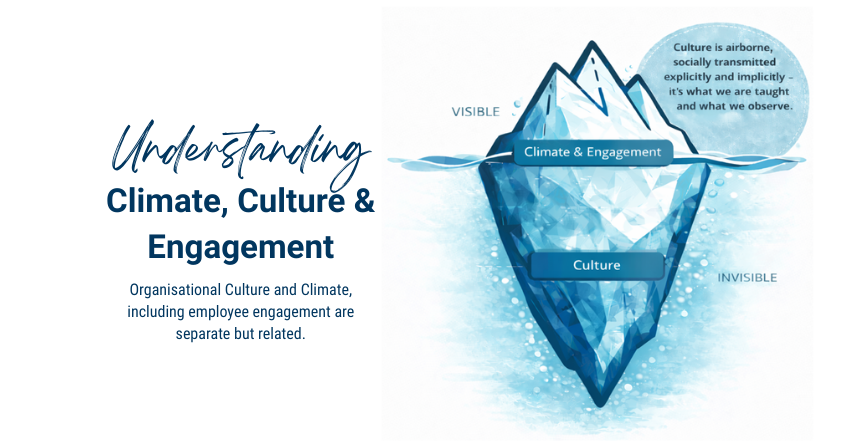
Engaged Today, Struggling Tomorrow?
Look at Your Culture!
In today’s organisational conversations, two terms often dominate leadership agendas: culture and engagement. On the surface, these two concepts may seem closely related — and they are — but equating them can lead to strategies that improve how employees feel today without addressing what really drives how they behave tomorrow. Understanding the difference between culture and engagement — and recognising why culture is the deeper, longer-term driver — is essential for sustainable performance.
Culture, Engagement — Same or Different?
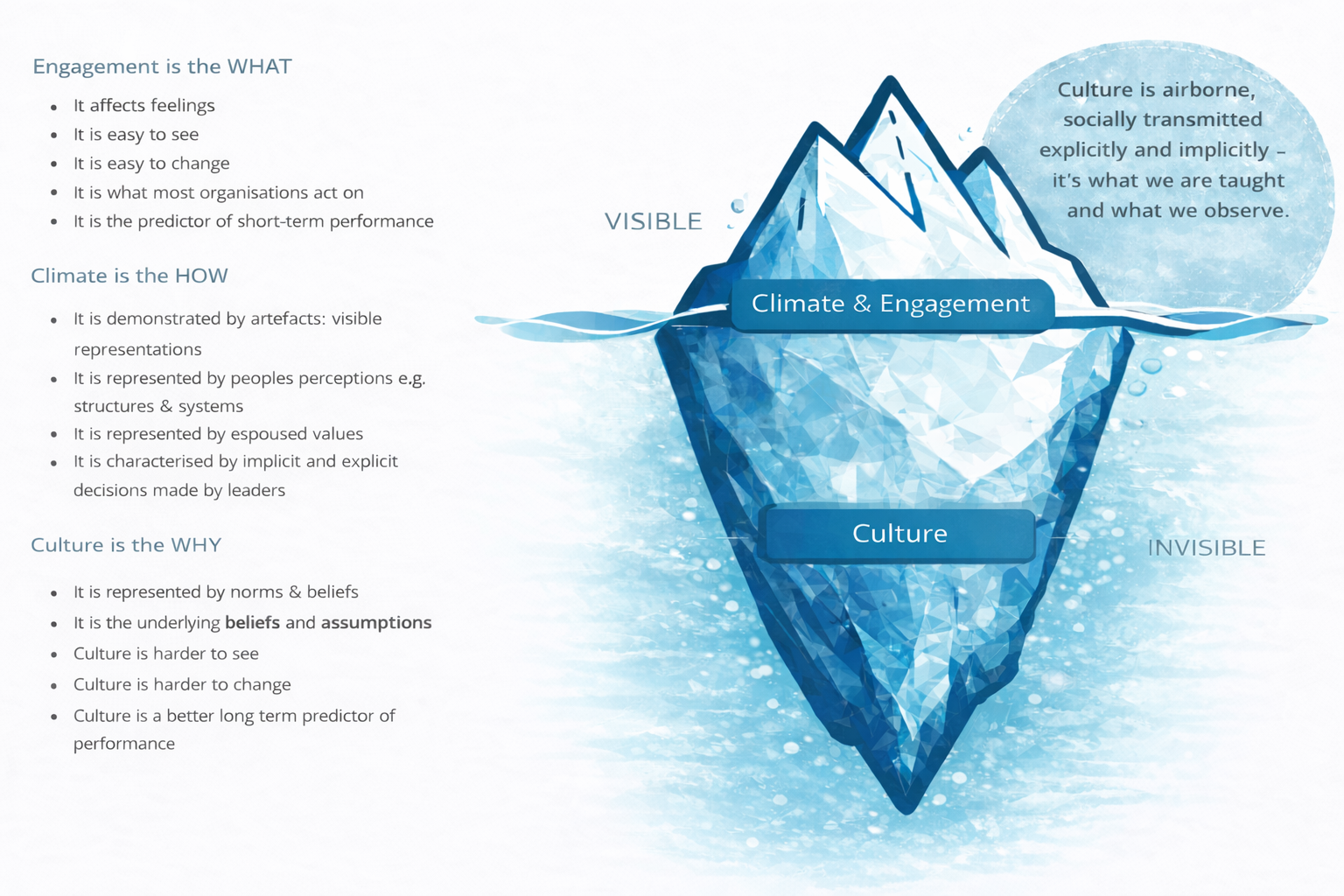
Engagement refers to how connected, motivated, and emotionally invested employees feel in their work. It’s often visible, simple to measure, and responsive to short-term interventions like recognition programs or workplace perks. But while high engagement can reflect positive sentiment, it doesn’t cause culture — it’s more often a result of it.
Culture, in contrast, represents the shared norms, beliefs, and expectations that shape behaviour in an organisation — the “why” behind how things get done. It’s grounded in what people believe they must do to fit in and be successful, shaping not just perceptions but actual behaviour over time. Culture is harder to observe and slower to change, but it is a better long-term predictor of organisational performance.
Put simply:
- Engagement = what people feel
- Culture = what people do
- And while engagement can shift quickly, culture is embedded and enduring.
Why the Distinction Matters
Organisations can sometimes show high engagement scores even when their culture isn’t supportive of long-term success. Engagement might rise after a morale-boosting initiative — but if the underlying norms still reward avoidance, power or oppositional behaviour styles, those feelings won’t translate to sustained performance.
Conversely, organisations with constructive cultures — where collaboration, achievement, and innovation are expected and rewarded — are more likely to generate engagement that matters because it’s rooted in shared norms that support growth and adaptability. This means leaders need to shift focus from short-term engagement wins to deeper cultural dynamics that shape behaviour over time.
OCI: A Tool for Understanding and Shaping Culture
To help organisations navigate this deeper layer, Human Synergistics developed the Organisational Culture Inventory® (OCI) — a globally recognised culture assessment tool that measures the shared behavioural norms within an organisation.
Unlike engagement surveys, the OCI doesn’t just capture how people feel — it reveals the behaviours employees believe are required to “fit in” and meet expectations. It analyses culture across three broad clusters:
- Constructive styles: where people are encouraged to work collaboratively, innovate, and focus on achieving results in healthy ways.
- Passive/defensive styles: where people act in ways that protect themselves, avoid risk, and minimise conflict.
- Aggressive/defensive styles: where behaviours are competitive or controlling, even at the expense of others.
By mapping culture through the OCI, leaders can see which norms dominate today and where shifts toward more constructive behaviour are needed to support long-term performance. This provides a foundation for targeted cultural development, rather than reactive engagement tactics that treat symptoms rather than causes.
The Long-Term Advantage of Constructive Culture
Research consistently shows that organisations characterised by constructive culture norms outperform others on key outcomes — including innovation, teamwork, leadership effectiveness, adaptability, and resilience. Constructive norms help people interact well with one another, approach tasks proactively, and solve problems effectively — all essential for navigating complexity and driving sustained results.
And while engagement remains important — it reflects how employees experience their environment — culture is what shapes that experience. High engagement without a healthy culture may feel good temporarily, but it won’t sustain performance when challenges arise. By contrast, a constructive culture creates a context where engagement flourishes naturally and continuously.
Leading on Culture, Not Just Engagement
When leaders recognise the difference between engagement and culture — and build a strategy that prioritises constructive norms — they unlock deeper behaviour change, stronger performance, and sustainable success over the long term.
Would you like to know more?
If you’d like more information on how Human Synergistics can work with you in 2026 on both culture and engagement please email us on info@human-snergistics.com.au or call us on 02 9247 6310 for a free and confidential chat .
For more information on the difference between culture and engagement download our whitepaper here