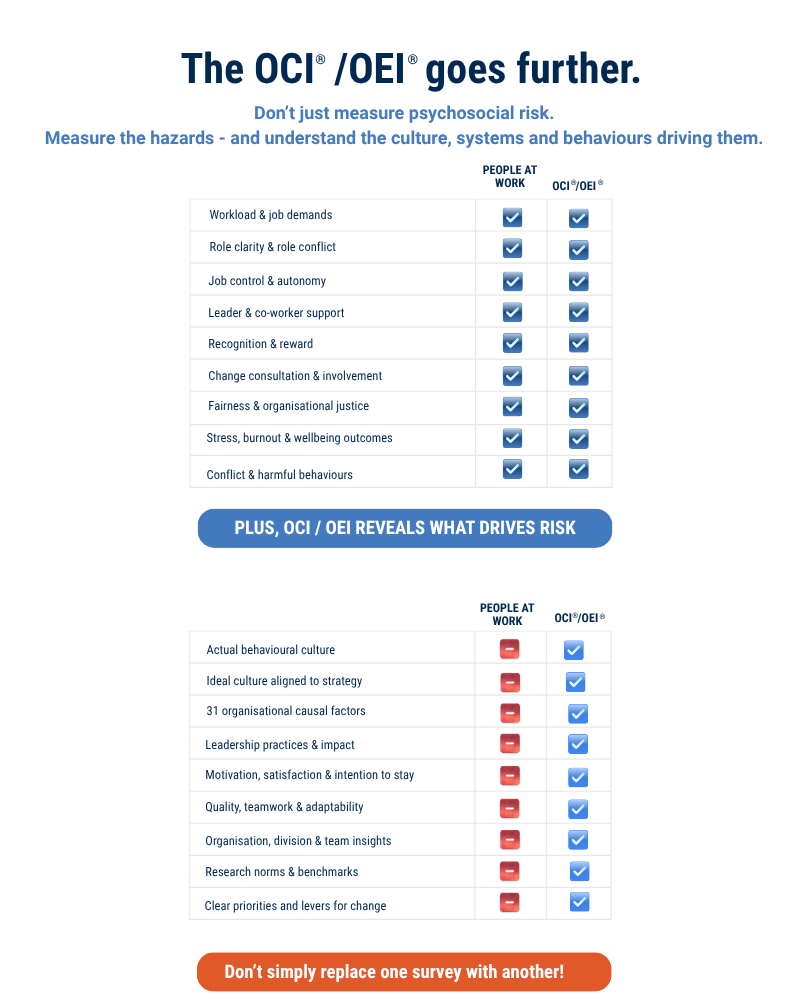
Go beyond measuring risk. Understand what’s driving it.
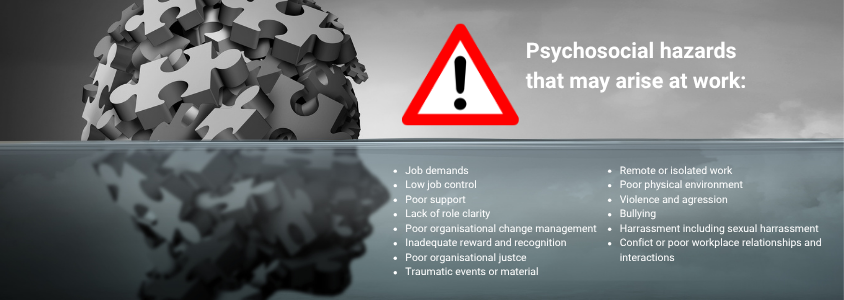
Psychosocial hazards don’t exist in isolation. They are influenced by how work is designed, how people are led and what employees experience every day.
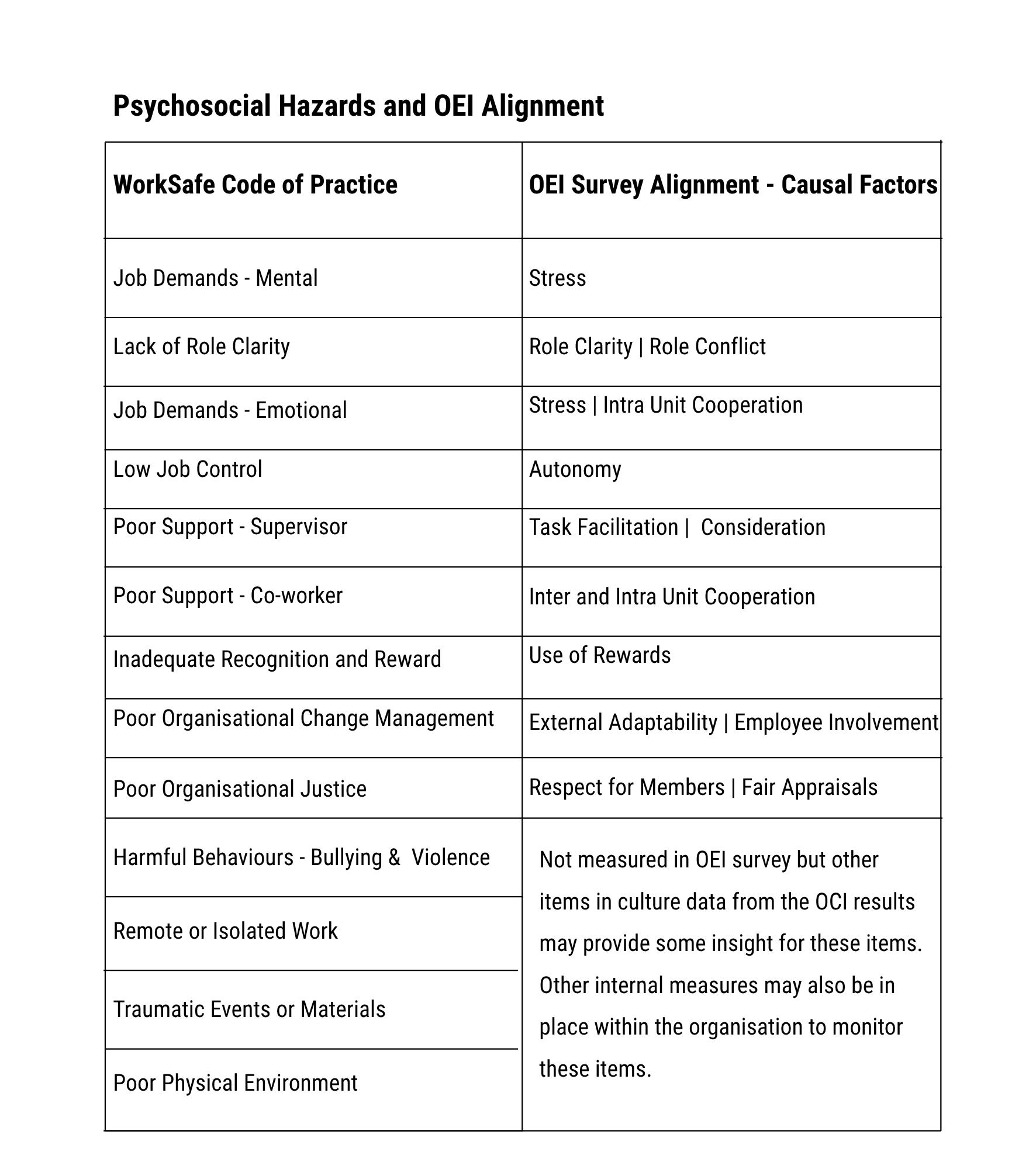
OCI and OEI provide insight into factors associated with:
✓ Job demands and stress
✓ Job control and autonomy
✓ Supervisor and co-worker support
✓ Role clarity
✓ Change management
✓ Recognition and reward
✓ Organisational justice
✓ Workplace culture and behavioural norms
By connecting these organisational conditions with the behaviours being encouraged and reinforced, you can move from simply identifying risk to understanding the conditions that may be contributing to it.
Psychological Safety Has Become a Governance Issue
Creating psychologically safe workplaces has always been good leadership. Today, it is increasingly becoming a governance and work health & safety responsibility.
SafeWork NSW’s 2026–27 Regulatory Statement identifies psychosocial risks as one of only four regulatory priorities for the year ahead. More importantly, the regulator has made it clear that organisations will be expected to demonstrate effective risk management—not simply rely on policies, awareness campaigns or wellbeing initiatives.
This reflects an important shift:
Old mindset
We have wellbeing initiatives.
New expectation
We can demonstrate that we’ve identified psychosocial hazards, consulted our people, implemented controls and regularly evaluate whether those controls are working.
Why this matters
In the past 12 months SafeWork NSW recorded:
- 2,200+ requests for service relating to psychosocial hazards
- 190+ notified workplace incidents involving psychosocial risks
These numbers reinforce that psychological health is now being managed with the same level of regulatory attention as physical workplace hazards.
Measuring What Creates Psychological Safety
Psychological safety cannot be improved through awareness alone.
Organisations need to understand which aspects of their culture, leadership and systems are creating unnecessary psychosocial risk.
Human Synergistics’ diagnostic framework helps organisations move beyond perception surveys by identifying:
- behavioural norms that influence psychological safety
- leadership strategies that either enable or inhibit open communication
- organisational systems that contribute to workload, trust and collaboration
- cultural factors that influence wellbeing, innovation and performance.
By measuring these underlying drivers, organisations gain practical evidence to support meaningful culture improvement—not simply wellbeing initiatives.
From Culture Measurement to Demonstrable Action
The expectation from regulators is increasingly moving beyond asking whether organisations value psychological safety.
The question is becoming:
Can you demonstrate how you identify psychosocial risks, measure them, implement improvements and evaluate whether those improvements are working?
Ready to move beyond wellbeing surveys?
The Organisational Culture Inventory® (OCI®) and Organisational Effectiveness Inventory™ (OEI™) help organisations understand the behavioural, leadership and systemic factors that influence psychological safety and psychosocial risk.
Talk to Human Synergistics about measuring the drivers of a psychologically safe workplace.
For many organisations, this means combining culture measurement with practical organisational development to create documented evidence of continuous improvement.
Would you like to speak to us about eliminating risks in your Organisation? We’re here to help:
📧 cst.support@human-synergistics.com.au
📞 02 9271 5900
Or simply login to your AP Portal for more details
 Listen here to our Culture Bites Podcast where we map Safe Work Australia’s “Managing Psychosocial Hazards at Work” Code of Practice to Human Synergistics’ Organisational Culture/Effectiveness Inventories (OCI/OEI) Culture measure.