
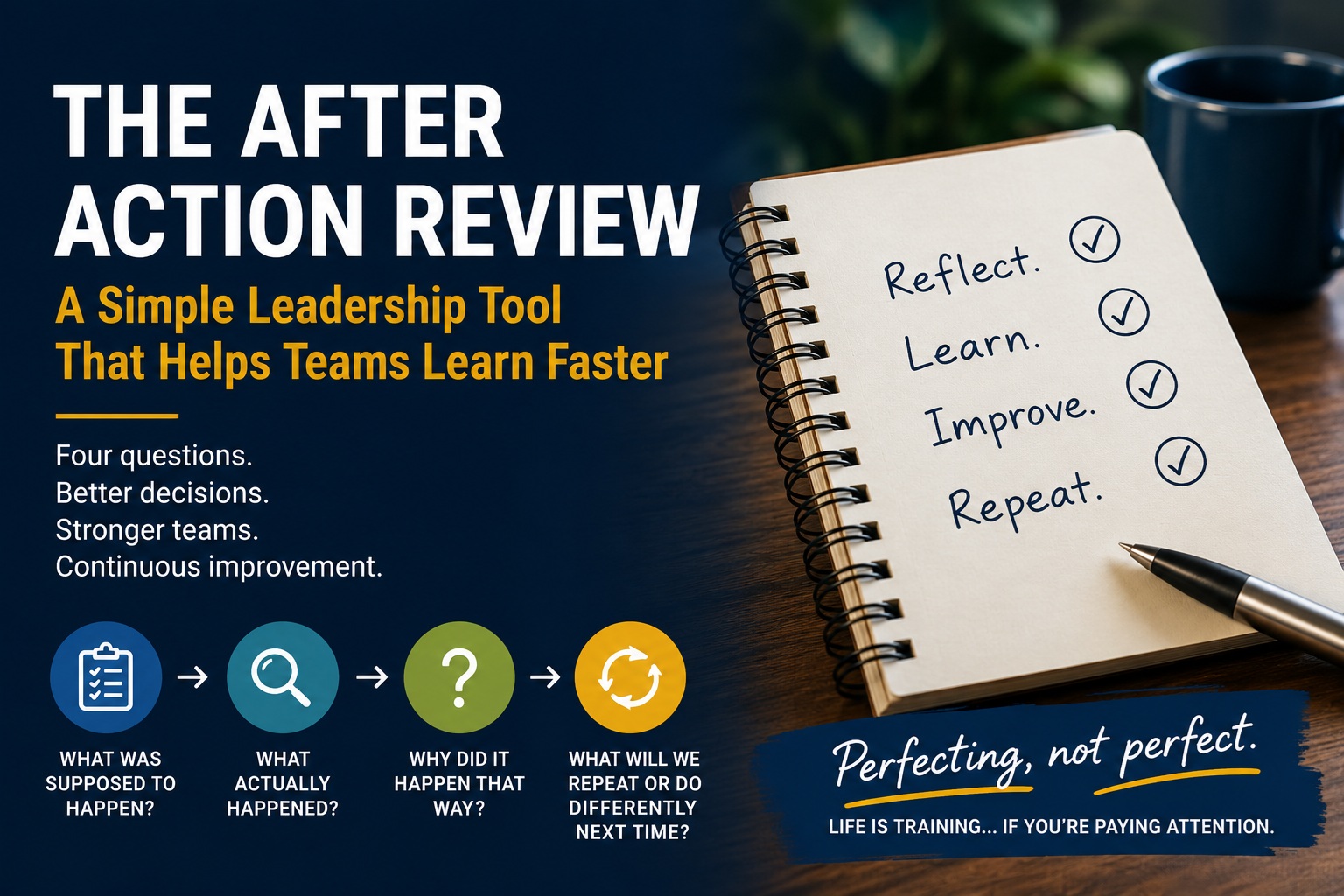
How four simple questions can create a culture of continuous improvement.
What if one of the most powerful leadership tools took less than five minutes to use?
No complicated framework. No expensive software. Just four questions that help you and your team learn from experience and improve over time. It’s called the After Action Review (AAR), and while it has its roots in the military, it’s one of the most practical leadership habits any team can adopt. If you’re looking for a simple way to improve team performance, build a culture of learning, and help people become more Achievement-oriented, the After Action Review deserves a place in your leadership toolbox.
Listen to this Episode on the Culture Bites Podcast:
What Is an After Action Review?
An After Action Review is a structured reflection that takes place after an event, meeting, presentation, project or conversation. Its purpose isn’t to judge performance. Its purpose is to improve performance. Rather than asking, “Who got it wrong?”, an After Action Review asks, “What can we learn so we perform even better next time?” That’s an important distinction. High-performing teams don’t just accumulate experience – they learn from experience.
AAR and the Flying Roulettes
We first explored this idea on the Culture Bites podcast with former naval aviator and Roulettes display pilot David Walker. David explained that after every flight, the team conducted an After Action Review. Not because something had gone wrong. Not because there had been an incident. After every flight. The goal wasn’t perfection. It was continuous improvement. David described it with a phrase that perfectly captures the mindset: “Perfecting, not Perfect”.
That simple distinction changes everything. If your goal is to be perfect – or perhaps more realistically, to appear perfect – then feedback feels threatening. Mistakes need to be defended. Excuses become tempting. Learning slows down. But if your goal is perfecting, every experience becomes an opportunity to improve. That’s the mindset great leaders create.
The Four After Action Review Questions
The beauty of the After Action Review is its simplicity. Every review follows the same four questions:
1. What was supposed to happen?
Start by clarifying the objective. What outcome were you trying to achieve? Without a clear picture of success, it’s difficult to evaluate what happened.
2. What actually happened?
Stick to the facts. Avoid blame, judgement or assumptions. The moment people start defending themselves, learning stops. The goal is an honest and realistic assessment of reality.
3. Why did it happen that way?
This is where the learning happens. Instead of asking who is at fault, ask what created the outcome. Understanding cause and effect allows teams to improve future results.
4. What will we repeat or do differently next time?
Learning isn’t just about fixing mistakes. It’s also about identifying what worked well and deliberately repeating those behaviours. Success leaves clues too.
Why After Action Reviews Improve Team Performance
One of the biggest mistakes organisations make is only reviewing failures:
- The project goes badly.
- A client is lost.
- A deadline is missed.
Only then does the team stop to reflect.
High-performing teams do the opposite. They review everything:
- Sales meetings
- Client conversations
- Project milestones
Every experience contains lessons. The teams that improve the fastest are simply the teams that learn the fastest.
Small Improvements Compound
Think about going to the gym. Nobody gets fit because they had one incredible workout. Fitness comes from small improvements repeated consistently over time. Leadership works exactly the same way. A two-minute After Action Review after a client meeting may not seem significant. But imagine doing that after every important interaction for a year. The learning compounds. Small improvements become major gains.
Build Leadership Capability That Lasts
The After Action Review is one simple leadership habit – but lasting improvement comes from building a broader set of leadership capabilities across your organisation.
Our Leadership Development Consulting Solutions help leaders develop the mindset, behaviours and practical tools needed to create high-performing teams and constructive workplace cultures.
Whether you’re developing frontline leaders, senior executives or leadership teams, we can help build the capability that drives sustained performance.

Frequently Asked Questions
What is an Action Action Review?
An After Action Review (AAR) is a structured reflection process used after a meeting, project or event to identify what happened, why it happened, and what can be improved next time.
What are the four After Action Review questions?
The four questions are:
- What was supposed to happen?
- What actually happened?
- Why did it happen that way?
- What will we repeat or do differently next time?
How long should an After Action Review take?
Most After Action Reviews take between 2 and 10 minutes. Larger projects may require a longer team debrief, but even a short review can create valuable learning.
Why do an After Action Review?
After Action Reviews encourage teams to reflect on their experiences, identify causes rather than blame, and continuously improve. Over time, they help build a culture of learning, feedback and high performance.