







Build Better Team Performance with the Group Styles InventoryTM (GSI)
High-performing teams do not happen by chance. The Group Styles Inventory™ helps teams understand how they work together when solving problems, making decisions, and navigating challenges, so they can improve collaboration, strengthen alignment, and achieve better results.
Research based team development for leadership teams, project teams, and intact teams
Trusted By
Develop a Team That Works Better Together
When teams are under pressure, patterns show up fast. Meetings become less productive. Good ideas go unheard. Decisions take too long or fail to stick. Collaboration becomes harder than it should be.
The Group Styles Inventory™ gives teams a practical, research based way to understand those patterns and improve how they interact. It helps teams build greater synergy, strengthen team effectiveness, and improve the quality of problem solving and decision making. The current GSI page describes it as a proven, valid, and reliable measure of how people in groups interact and work as a team, while the Groups & Teams page positions it as a tool to help groups achieve better outcomes through constructive teamwork and problem solving.
Why Teams Use the Group Styles InventorTM (GSI)
Improve Team Effectiveness
Help teams see what is supporting performance and what is getting in the way, so they can work together more effectively.
Strengthen Collaboration
Create a safer, more productive way to talk about team dynamics, communication, and working relationships.
Build Better Decision Making
Support teams to make higher quality decisions with stronger participation, clearer thinking, and greater buy in.
Lift Problem Solving Capability
Give teams insight into how they approach challenges together and how to improve solution quality.
Encourage Innovation and Idea Sharing
Surface the conditions that help teams contribute openly, challenge constructively, and think more effectively together.
Track Improvement Over Time
Use GSI as part of an ongoing team development process, not just a one off workshop.
What is the Group Style InventoryTM?
The Group Styles Inventory™ is a team development tool that measures how people in groups interact with one another and approach problems and decisions. Rather than focusing on personality labels, it helps teams understand the shared thinking and behavioural patterns shaping their effectiveness in the moment. The current site describes GSI as the only research-based tool of its kind and says it provides a safe way for groups to talk about behaviour and its impact on team performance.
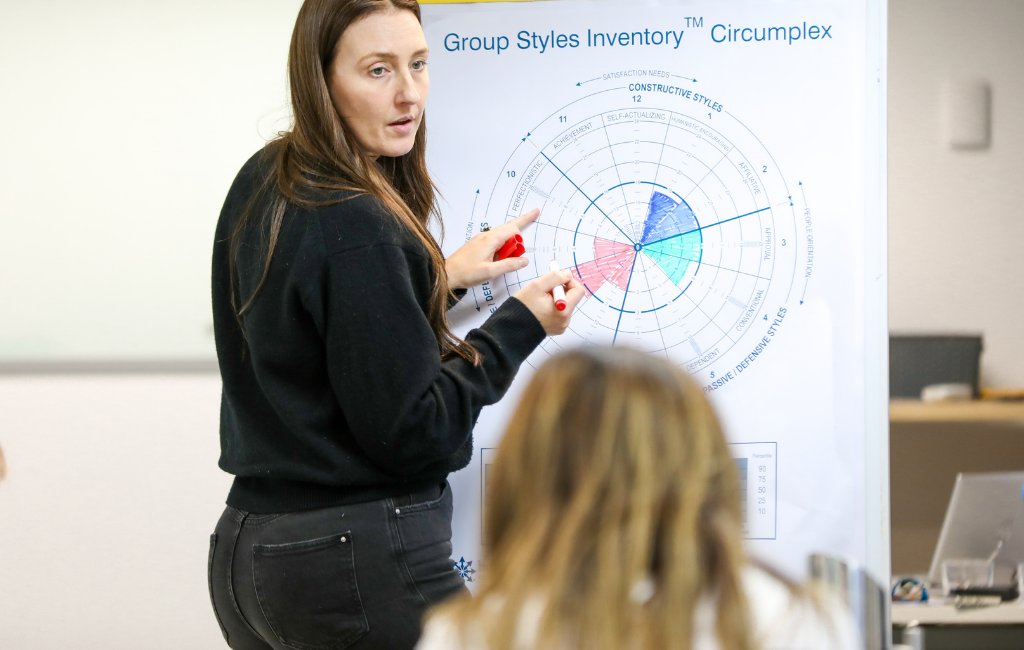
Grounded in the Human Synergistics Circumplex®, GSI gives teams a common language to explore how they are operating, what is helping performance, and what needs to shift to create more constructive teamwork. Your workshop material also frames GSI as a way to give participants a framework and language to discuss behaviour, with insights extending beyond team dynamics to individual thinking and behaviour as well.
Team members complete the survey
Participants respond to 72 statements about teamwork behaviours, including team effectiveness, solution acceptance, solution quality, and team synergy. The survey takes about 15 minutes.
Individual and team results are profiled
Participants receive access to their own results as well as the combined team profile through the real-time portal, supported by an integrated development guide.
Teams debrief and identify actions
A Human Synergistics consultant or accredited practitioner guides the team through the results and helps facilitate the conversation that matters: how are we performing, and what do we need to change?
Better Team Conversations. Better Team Results.
Many teams know they could work better together, but they struggle to pinpoint why. GSI helps teams move beyond vague discussions about communication or teamwork and into a more practical, constructive conversation about team behaviour, effectiveness, and performance.
It helps teams understand:
- how they approach problem-solving and decision-making
- what improves or reduces team synergy
- where collaboration is breaking down
- how to create stronger ownership and solution acceptance
- what constructive shifts will improve overall team effectiveness
Who Uses the GSI:
Leadership Teams & Senior Leaders
Use GSI to improve how leadership teams work together, make decisions, and align around priorities. Build stronger collaboration at the top and role model constructive team behaviour where it matters most.

Project, Cross Functional & Operational Teams
Teams use GSI to strengthen collaboration, improve problem-solving, and make better decisions under pressure. Create clearer communication, stronger alignment, and greater ownership of outcomes across day to day work.

Leadership & Development Experts
HR and L&D teams use GSI within team development programmes to improve team effectiveness, support collaboration, and lift performance. It provides a practical framework for building high-performing teams.

Coaches, Consultants, & Internal Change Agents
Accredited practitioners use GSI to facilitate deeper team conversations, diagnose team dynamics, and support behaviour change over time. Use GSI to create meaningful, measurable shifts in team performance. Become accredited to use GSI with your clients.

Human Synergistics Consulting
We work alongside you to turn team insights into action — supporting team development, improving team effectiveness, and strengthening collaboration, problem solving, and decision making. Learn more
Our Network of Accredited Team Development Consultants
Looking for a facilitator to support your team? We have a network of accredited consultants across Australia and beyond who specialise in team development and improving team effectiveness using GSI. Search “Group Styles Inventory” on LinkedIn.
Become Accredited in Team Development with GSI
Build internal capability to run team development workshops and debrief GSI results. Become accredited to facilitate powerful conversations and drive measurable improvements in team performance and effectiveness. Learn more about becoming Accredited.


